2025 marked a turning point
for the sync industry.
Music decisions at scale were no longer driven purely by creative instinct or anecdotal trends. Instead, they were increasingly shaped by observable performance signals, platform behavior, and downstream outcomes across television, streaming, radio, and digital media.
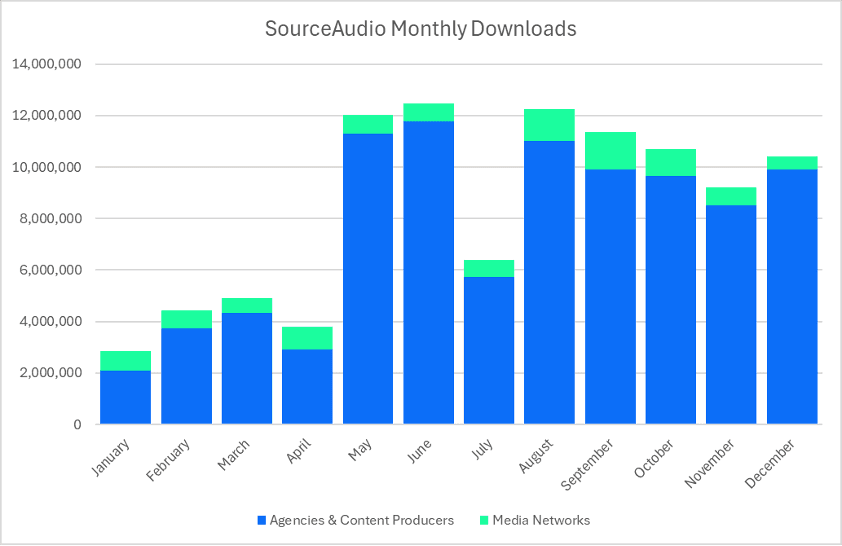
Sync activity on the SourceAudio platform continued to scale in 2025, reflecting both increased usage and a broader expansion of available music. Total downloads rose significantly year over year, increasing from roughly 60 million in 2024 to more than 95 million in 2025, while overall plays also climbed.
At the same time, the size and diversity of the catalog expanded meaningfully. Total tracks on the platform grew from approximately 28 million to more than 34 million, with unique tracks increasing by over 4 million year over year. This growth reflects not just volume, but a wider range of music being made available and actively used across television and broadcast workflows.
Together, these shifts supported a more blended, pragmatic approach to sourcing music, shaped less by category labels and more by how quickly and effectively a track could serve a specific creative need.
Sync activity on the SourceAudio platform continued to scale in 2025, reflecting both increased usage and a broader expansion of available music. Total downloads rose significantly year over year, increasing from roughly 60 million in 2024 to more than 95 million in 2025, while overall plays also climbed.
At the same time, the size and diversity of the catalog expanded meaningfully. Total tracks on the platform grew from approximately 28 million to more than 34 million, with unique tracks increasing by over 4 million year over year. This growth reflects not just volume, but a wider range of music being made available and actively used across television and broadcast workflows.
Together, these shifts supported a more blended, pragmatic approach to sourcing music, shaped less by category labels and more by how quickly and effectively a track could serve a specific creative need.
How Buyers Search and Select Music
One of the clearest shifts in 2025 was how buyers approached discovery.
Search behavior increasingly prioritized mood, energy, pacing, and emotional intent over traditional genre labels. Creative teams searched for how music should feel and function, not what genre it belonged to. This change reflected how storytelling itself is evolving across fragmented attention environments and multi-format distribution.
From sustained platform search behavior, several consistent patterns emerged.
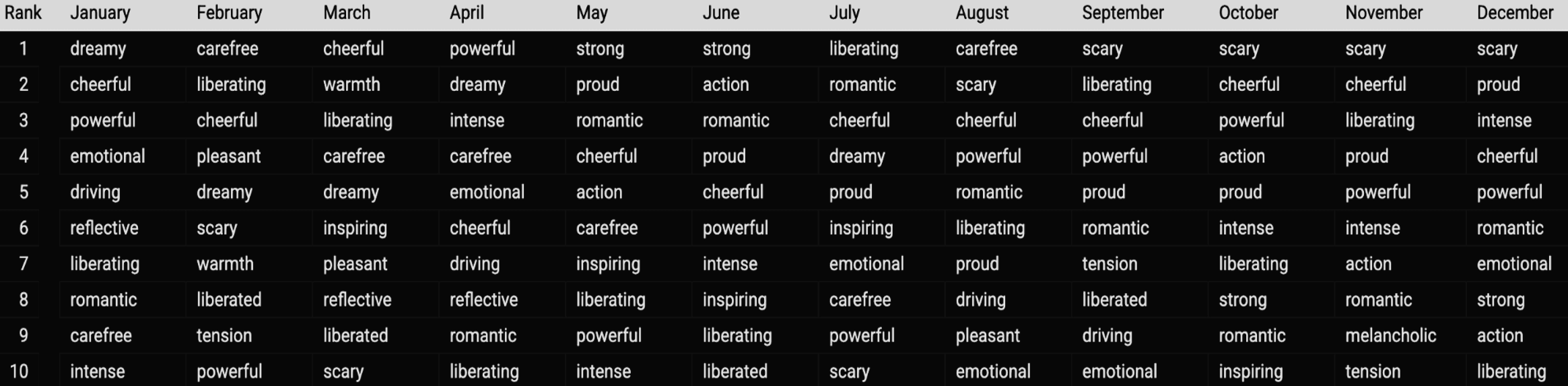
Moods That Over-Indexed by Month in 2025
Emotionally descriptive terms outpaced genre-based searches, with particular emphasis on clarity of mood, forward momentum, and adaptability across edits. Mid-to-up-tempo music with defined builds, clean transitions, and flexible structure consistently surfaced in discovery workflows.
Fast-growing search categories centered on utility and context. Terms related to tension, momentum, uplift, and restraint appeared more frequently than stylistic descriptors, especially within television and streaming network workflows.
Clear differences also emerged by buyer type.
Network teams prioritized speed, reliability, and edit-friendly music that could move quickly from search to air. Agencies leaned toward expressive and brand-aligned attributes, while brand-side users focused on emotional clarity and versatility across touchpoints.
Across all groups, efficiency and confidence in decision-making became as important as creative exploration.
Clear differences also emerged by buyer type.
Network teams prioritized speed, reliability, and edit-friendly music that could move quickly from search to air. Agencies leaned toward expressive and brand-aligned attributes, while brand-side users focused on emotional clarity and versatility across touchpoints.
Across all groups, efficiency and confidence in decision-making became as important as creative exploration.
When licensed music was tracked into real-world performance across television, radio, YouTube, and streaming environments, certain attributes consistently correlated with longer usage life and broader deployment.
Music with a strong emotional throughline, flexible structure, and balanced energy tended to travel further across promos, episodes, and supporting content. Tracks that supported narrative without overpowering dialogue or visuals were more likely to be reused and extended across formats.
This is where sync becomes less about guesswork and more about understanding how music choices perform in the real world.
The next phase of sync is not about more music. It is about better decisions.
As 2026 approaches, the most effective teams will be those that combine creative instinct with insight drawn from real-world usage and performance. Music is no longer simply supporting content. It is actively shaping how content is experienced, remembered, and scaled.
This is the context in which initiatives like Sync Smarter are emerging within the SourceAudio ecosystem. Not as a replacement for creative judgment, but as a way to surface insight that already exists. Insight that helps creative teams understand what is resonating, how different formats behave, and where certain musical attributes consistently travel further once in market.
The shift underway is clear. Sync is moving from intuition-driven selection toward intelligence-informed design. That evolution is already visible in the data.